Motion-Preserving Spine Surgery: A Modern Spinal Fusion Alternative
From productivity and personal time to sleep and exercise, back and neck pain are highly disruptive to everyday tasks. Because disc damage limits your ability to function, orthopedic spine specialists often recommend solutions like physical therapy first to restore strength and movement. If physical therapy or other initial treatments don’t work, surgery is likely the next step.
Traditionally, many patients have been told that spinal fusion is the preferred procedure, but today, modern alternatives exist. Motion-preserving spine surgery is a spinal fusion alternative designed to protect your mobility. The spine surgeons at DMOS in Des Moines are here to answer your questions and ensure you move forward with the most effective treatment plan to relieve pain and get back to living.
What Is Motion-Preserving Spine Surgery?
Motion-preserving spine surgery consists of an artificial disc replacement, inserting a flexible artificial implant in place of the damaged disc. This procedure promotes natural movement in the spine, allowing for a more active lifestyle compared to spinal fusion, which permanently joins two vertebrae together, limiting spinal mobility. As an innovative alternative to spinal fusion, motion-preserving surgery enables an active lifestyle.
What’s The Difference: Artificial Disc Replacement Vs. Spinal Fusion?
Compared to spinal fusion, artificial disc replacement surgery preserves motion and provides a faster recovery to return to doing what you love. Whether performing cervical disc arthroplasty (replacement) or a lumbar artificial disc replacement surgery, professionals specializing in motion-preserving spine surgery relieve the pain in your neck or back without altering the natural flexibility and movement patterns (referred to as the biomechanics) of your spine.
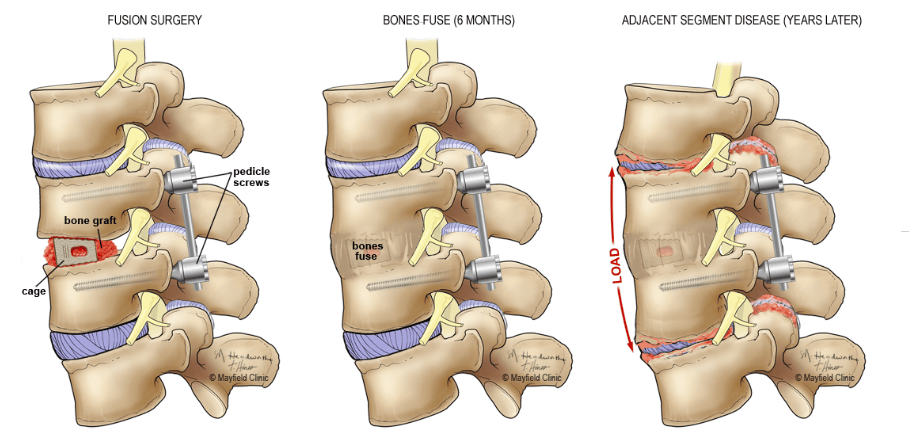
As a result, surrounding discs don’t have to compensate to make up for a stiff back, reducing stress on the discs above and below the treated area. Preserving motion may also help to reduce the risk of adjacent segment disease, which is depicted after fusion surgery in the image above, courtesy of Mayfield Brain & Spine. This lowers the likelihood of future revision surgery. Comparing modern-day artificial disc replacements vs. traditional spinal fusion, patients have more options than ever to restore range of motion for chronic pain or following an injury.
| Motion-Preserving Spine Surgery |
Spinal Fusion |
| Replaces damaged disc with artificial implant |
Joins two vertebrae so the bones heal as one stable segment |
| Preserves movement at the spine |
Limits movement at the treated level |
| Maintains natural biomechanics |
Alters spinal mechanics |
| Less stress on surrounding discs |
May place additional stress on surrounding discs |
| Faster return to normal activity (often within 6–12 weeks) |
Longer to achieve full recovery (often within 6–12 months) |
| Often recommended for active patients when mobility is the priority |
May be necessary for certain conditions when stability is the priority |
Types Of Artificial Disc Replacement
Spinal disc replacement surgery, also known as spinal disc arthroplasty, effectively relieves pain and restores mobility for your neck or lower back depending on the location of the damaged disc. Cervical disc replacement and lumbar disc replacement are two types of artificial disc replacement surgery designed to not only help you stay active but also get back to the activities you love sooner.
Cervical Disc Replacement
Cervical disc replacement, or cervical disc arthroplasty, is used to treat conditions in the neck, including:
- Herniated discs causing arm pain or numbness
- Pinched nerve (cervical radiculopathy)
- Spinal cord compression (in select cases)
- Degenerative disc disease
Orthopedic spine specialists often recommend cervical disc replacement for active patients who desire a faster recovery timeline. The procedure allows you to maintain neck mobility and return to sedentary work within 2-4 weeks. Full activity typically resumes sooner than after a traditional spinal fusion.
Lumbar Disc Replacement
Lumbar artificial disc replacement surgery (or arthroplasty) refers to a motion-preserving procedure to treat conditions in the lower back when other treatments like medication, injections or physical therapy aren’t effective. Treatable conditions include select cases of:
- Degenerative disc disease
- Low back pain stemming from a damaged disc (discogenic pain)
- Single-level disc collapse
Lumbar disc replacement is particularly appealing for active individuals who want to maintain spinal motion and avoid the stiffness often associated with spinal fusion. A replacement also limits strain on surrounding discs to help reduce overall stress on the lower back and spine going forward.
Who Is A Candidate For Disc Replacement Surgery?
To determine your eligibility for disc replacement surgery as a spinal fusion alternative, consult with your orthopedic spine specialist to discuss your options. You may be a candidate if pain is localized to one or two disc levels and non-operative treatments haven’t worked, as long as you have strong bones and don’t have a spinal deformity or advanced facet arthritis. Deformities like scoliosis typically must be addressed first before undergoing motion-preserving spine surgery, as the spine must be stable to undergo a disc replacement. Similarly, underlying conditions like arthritis might not be resolved with an artificial disc replacement because pain can still occur as a result of the condition.
Surgery usually isn’t the first-line treatment to neck or back pain. Early treatment allows non-operative measures like medication, physical therapy or injections to manage symptoms. Spine specialists can provide a comprehensive evaluation of your neck or back, including diagnostic imaging, a physical examination or functional assessments to identify treatment eligibility. If surgery is determined to be the best option, your surgeon will explain whether disc replacement surgery is a viable option.
Patients Across Des Moines Trust DMOS Spine Surgeons
Our board-certified and board-eligible spine surgeons provide specialized orthopedic care in the Des Moines metro, committed to restoring mobility and quality of life. The entire team at DMOS ensures coordinated care from your initial consultation through your recovery, including physical therapy and rehabilitation to get moving again after your motion-preserving spine surgery. Spine surgeon Dr. Brian Handal speaks to the quality of care you can expect at DMOS:
“Our goal is to help patients return to active, pain-free living with advanced motion-preservation techniques, evidence-based, personalized treatments and collaboration between our orthopedic spine specialists and physical therapists,” Dr. Handal said. “Patients are able to return to living with improved mobility.”
Connect With Our Orthopedic Spine Specialists To Get Back To Living
Living in pain doesn’t have to be your reality. Connect with DMOS at one of our convenient locations in the Des Moines metro for an initial evaluation or referral to work with our orthopedic spine specialists. We will then work with you to determine if surgery is needed and discuss whether an artificial disc replacement is an option. We’ll let you know if a cervical or lumbar disc replacement is right for you.
Learn More